Planning bikeshare beyond docks and zones
How should a city expand bikeshare: with fixed stations, out of station parking areas, or a hybrid of both? The choice shapes ridership, capital cost, operations, and how well the system connects to transit.
Interactive-OR’s new white paper, Station-Based, Out of Station Parking Areas, and Hybrid Bikeshare Systems, brings together operating-model comparison, international practice, and data-driven planning. It introduces BikeShare Pro, our platform for descriptive mapping, ridership forecasting, and network optimization, and applies it in a Hamburg case study and five global city analyses.
Click below for the white paper!
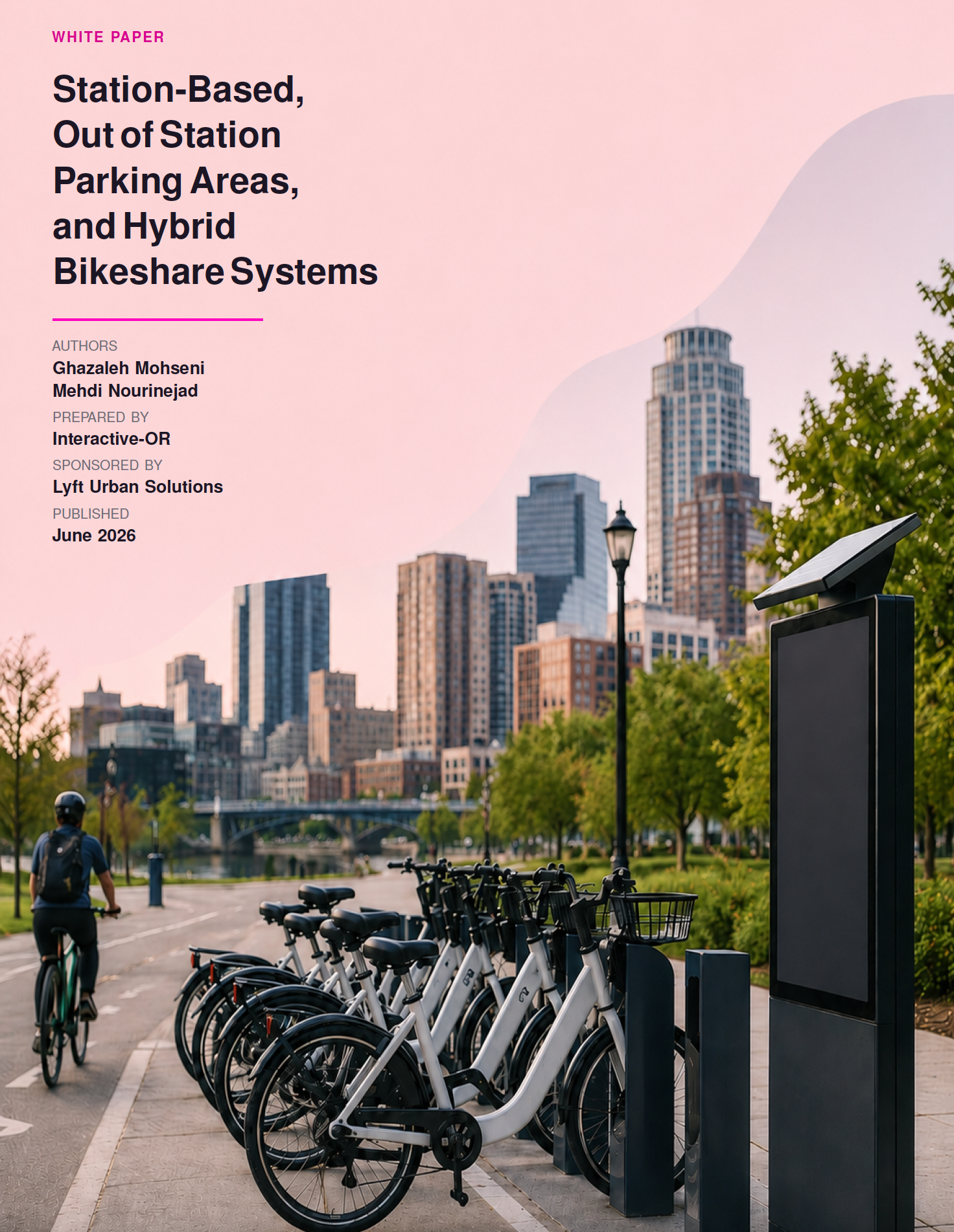
Written for transit agencies, mobility planners, and operators, the paper connects policy choices to measurable outcomes: expansion scenarios, capital intensity, fleet sizing, and where each service mode works best.
Inside the paper, you will find:
A clear comparison of docked, dockless, free-floating, and hybrid operating models
Best practices from cities in North America, Europe, and Asia
How BikeShare Pro supports descriptive, predictive, and prescriptive network planning
A Hamburg 2026 scenario study comparing dock-only, hybrid, and reverse-hybrid expansion
Cross-city deployment analysis for Paris, New York City, London, Copenhagen, and Montreal
Key takeaway: a balanced hybrid design can capture nearly all the ridership gains of a dock-only expansion at substantially lower capital cost; if stations and out of station parking areas are placed where demand and transit access justify them.